
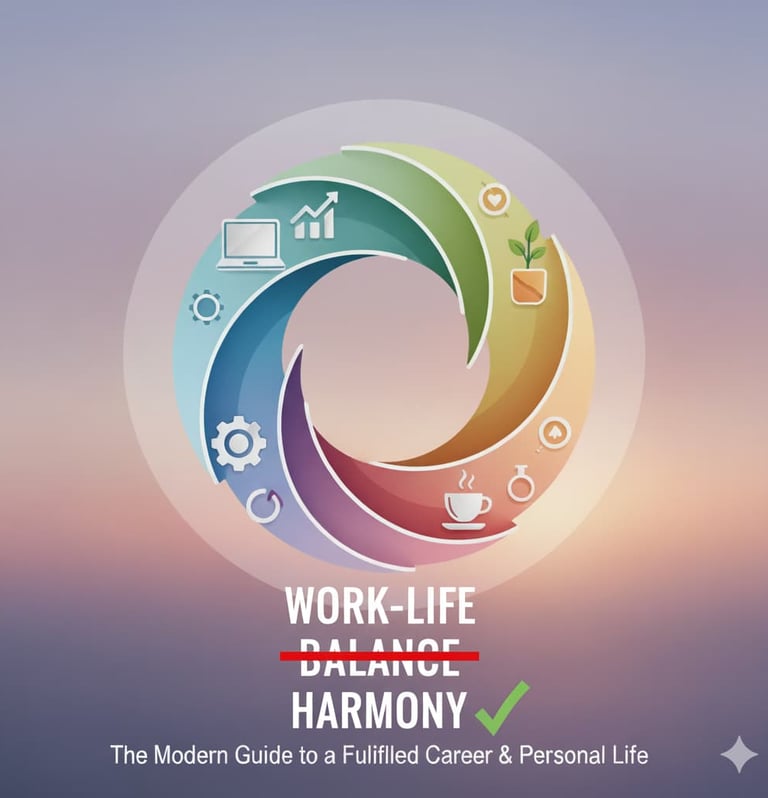
Work-Life Balance Is a Myth — Embracing Work-Life Harmony Instead
Work-life balance is outdated. Discover how work-life harmony helps doctors, IT professionals, and modern workers live purposefully without guilt.
Work-Life Balance Is a Myth — Embracing Work-Life Harmony Instead
For years, we’ve been told to chase “work-life balance” — that perfect midpoint where our professional and personal lives sit in equal measure. As a doctor, I once believed in that too. I’d finish rounds early, answer every message, squeeze in family time, exercise, and sleep — and still feel like I was falling short. That’s when it struck me: balance isn’t something you achieve; it’s something you constantly chase.
And it’s not just doctors. My friends in IT, corporate roles, and education face the same struggle — tied to screens, back-to-back meetings, and endless deadlines. The harder we try to “balance” everything, the more out of sync we feel. Maybe the problem isn’t our effort — maybe it’s the idea of balance itself.
It’s time to move beyond balance — and embrace work-life harmony.
Why Work-Life Balance No Longer Works
The traditional concept of balance treats work and life as two opposing forces — as though success in one must come at the cost of the other. But the modern world doesn’t operate that way.
Technology has dissolved boundaries. A patient might text me after clinic hours, just as an IT professional might get a Slack notification during dinner or an entrepreneur might brainstorm during a family holiday. Work and life are no longer separate — they blend, often seamlessly.
“Work-life balance” suggests we can evenly divide time and energy between the two. But reality demands flexibility. Some days, work needs more of you; on others, rest and relationships take precedence. The real key is not balance, but flow — a rhythm where both spheres enrich each other.
The New Paradigm: Work-Life Harmony
Work-life harmony is about integration, not separation. It’s a mindset that lets your personal and professional lives complement rather than compete.
In my own life, this shift has been transformative. When I counsel patients about healthy habits, I’m reminded to apply those same principles myself. Likewise, my friends in IT and business have learned to merge productivity with wellness — coding with mindfulness breaks, or team challenges that double as fitness goals.
Harmony allows you to bring your whole self to everything you do. You’re no longer dividing your identity between “professional” and “personal.” Instead, you’re aligning both with your deeper purpose.
From Balance to Harmony — A Mindset Shift
For too long, we’ve pictured work and life as two sides of a fragile scale. But life doesn’t unfold in perfect symmetry. Between on-call nights, virtual meetings, and family commitments, the idea of achieving “perfect balance” can feel exhausting — even impossible.
Harmony, however, offers a softer, more realistic mindset. It’s not about equal time; it’s about intentional alignment. When you work with purpose, your energy flows more freely, and your personal life benefits too. Helping a patient, solving a problem, or mentoring a junior colleague can be deeply fulfilling — and that fulfillment spills into every part of life.
The shift from balance to harmony invites us to stop counting hours and start cultivating meaning. Some days lean toward work, others toward rest — both are necessary. The goal isn’t a perfect split, but inner peace.
Real-Life Tips to Create Work-Life Harmony
Here are practical, experience-tested ways to build harmony — not guilt — into your daily life:
1. Redefine Priorities Daily
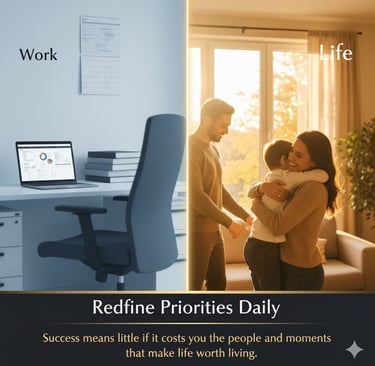
We often chase the illusion of perfect balance — trying to give equal time to everything and everyone. But real life doesn’t unfold that way. Instead, pause and ask yourself each morning: What truly deserves my energy today? Some days, your patients or projects may demand more of you. On others, it’s your family, your peace of mind, or simply rest that needs attention. True harmony lies in allowing these priorities to shift — gracefully and without guilt.
Here’s a thought I’ve often reflected on: If you were to disappear tomorrow, what would truly change? At work, someone else would take your place. Tasks would continue, meetings would be held, and life would move on. You might be missed — for a while. But eventually, you’d become a memory.
Yet for your family, that absence would leave an emptiness no one could ever fill. That truth humbles me every time.
So, learn to value the spaces where your presence truly matters. Be dedicated at work, yes — but not at the cost of what makes you human. Success means little if it costs you the people and moments that make life worth living.
2. Blend, Don’t Divide
True work-life harmony isn’t about drawing lines — it’s about blending your worlds with intention. As a doctor, I’ve found that patient conversations about wellness often remind me to check my own habits. Likewise, my friends in IT and corporate roles practice healthy work-life integration by meditating between coding sessions or joining team fitness challenges.
When work and life nourish each other, you create energy instead of exhaustion. Let your professional purpose fuel personal growth, and your well-being sustain your success. Work-life harmony begins when you stop separating who you are from what you do. Don’t build walls between your worlds — build bridges that help both thrive..
3. Protect Micro-Moments of Joy
You don’t need hours to recharge — just presence. Enjoy a quiet coffee, a short walk, or a heartfelt call. It’s not the duration but the depth of connection that restores you.
4. Set Compassionate Boundaries
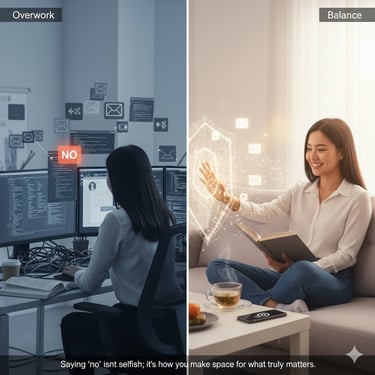
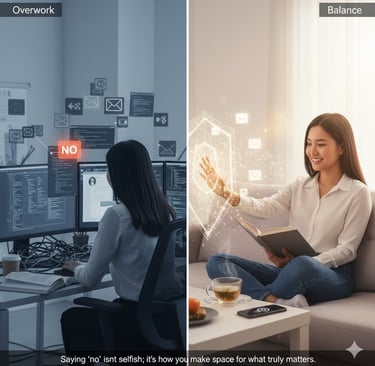
Work-life harmony doesn’t mean being constantly available — it means being consciously present where you’re needed most. Learning to say “no” with kindness is a vital skill. Decline extra shifts, unnecessary meetings, or late-night calls that drain you. Boundaries are not barriers; they are bridges to balance and better performance.
As doctors, we often normalize exhaustion, wearing overwork like a badge of honor. But burnout doesn’t serve our patients — or ourselves. The same applies across professions — IT, corporate, or academia — where saying “yes” too often erodes creativity and peace.
If you’re in a leadership role, remember that compassion flows both ways. Respect your team’s time. Acknowledge that your juniors, colleagues, and staff have lives, families, and dreams outside work. Healthy boundaries create healthier workplaces — where people thrive, not just survive.
Saying “no” isn’t selfish; it’s how you make space for what truly matters.
5. Prioritize Health Like a Prescription
As doctors, we tirelessly remind others to eat well, sleep enough, and move daily — yet so often, we forget to prescribe the same care to ourselves. Long shifts, irregular meals, and chronic sleep deprivation slowly chip away at our vitality. The same holds true for IT and corporate professionals, who spend endless hours seated, eyes fixed on screens, surviving on caffeine and convenience.
But health isn’t optional — it’s the foundation of work-life harmony. You can’t pour from an empty cup. Physical, mental, and emotional well-being are what sustain productivity, creativity, and compassion.
Think of your health as a non-negotiable daily prescription: nourish your body with wholesome food, rest your mind, and move with intention. Even ten mindful minutes can reset your energy. Because when you care for yourself first, you show up stronger — for your work, your family, and your purpose.
6. Practice Self-Compassion
There will be days you miss workouts or lose patience. Don’t dwell on guilt. Progress, not perfection, sustains growth. Be kind to yourself — that’s how harmony begins.
7. Reflect Weekly
Amid the chaos of deadlines and demands, weekly self-reflection is your pause button — a moment to breathe, reset, and realign. Take ten quiet minutes each week to ask yourself two simple but powerful questions: What energized me? What drained me?
This mindful exercise helps you recognize patterns that shape your days. For doctors, it might be the fulfillment that comes from patient care versus the fatigue of endless paperwork. For IT and corporate professionals, it could be the thrill of solving challenges contrasted with the drain of constant notifications.
Awareness is the first step toward mindful work-life balance. Over time, these reflections become your internal compass — guiding you toward choices that nourish peace, not pressure.
Remember, work-life harmony isn’t achieved by doing more, but by doing what truly matters. Reflection turns experience into wisdom — and wisdom into balance.
From Perfection to Presence
Work-life harmony isn’t about equal hours — it’s about feeling whole in whatever you’re doing.
Whether you’re a doctor saving lives, an IT professional creating systems, a teacher inspiring young minds, or an entrepreneur building dreams — harmony begins when your work reflects your values, and your life sustains your spirit.
As physicians, we witness daily how fleeting life can be. That awareness extends beyond hospitals: life isn’t meant to be balanced like a ledger — it’s meant to be lived in rhythm.
So, let’s stop striving for balance. Let’s create work-life harmony — where career and life collaborate, not compete, to build a more meaningful, fulfilling existence.
Because true harmony isn’t about doing it all — it’s about being at peace with what you choose to do.





Health
Care
Mind
contactus@bobbyabraham.com