
The Foods I'd Keep Away From My Child — A Doctor's List
Healthy eating for children isn't built on restriction—it's built on awareness. Pick just one item from this list to swap out this week. Small, consistent choices make all the difference.
The Foods I’d Keep Away From My Child — A Doctor’s List
Every parent wants to do right for their child. We read labels, we stress over screen time, and we track sleep schedules like clockwork. But one danger often slips under the radar—quietly, insidiously—right on the dinner plate.
As a doctor, we closely observe the human body, the livestyles we choose, the diseases our population suffers from. When you spend your hours analyzing diseases, and the systemic aftermath of chronic illness, you start to view food differently. You realize that long-term cellular and organ damage doesn't happen overnight; it is quietly built over years of micro-choices.
This isn't a fear-mongering list. It’s an honest, medical look at what we are feeding the next generation. Knowing what I know, here are the foods I think twice about giving a child—and the science behind why.I would limit these in adult menu as well,but now we are talking about kids.
The Silent Epidemic: Pediatric Fatty Liver Disease
Before diving into specific foods, we need to talk about a clinical reality that doesn't get nearly enough attention in parenting circles: Metabolic Dysfunction-Associated Steatotic Liver Disease (MASLD), historically known as Non-Alcoholic Fatty Liver Disease (NAFLD), in children.
Once considered an exclusively adult ailment, fatty liver disease is now being diagnosed in children as young as three years old. Globally, nearly 10% of all children—and up to 70% of children with obesity—are living with silent hepatic fat accumulation. The liver struggles in silence; most of these kids show absolutely no symptoms until significant, irreversible damage or fibrosis has already occurred.
The primary culprits aren't mystery toxins; they are excess fructose, refined carbohydrates, and ultra-processed fats. These inputs drive insulin resistance, force fat storage directly into liver cells, and trigger a state of low-grade, systemic inflammation that compounds over time.
Here are the four major dietary offenders I monitor most closely.
1. Liquid Candy: Sugar-Sweetened Beverages & Packaged Juices
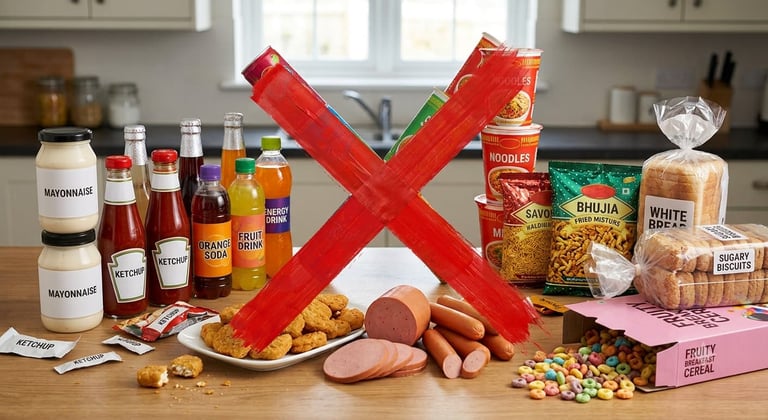
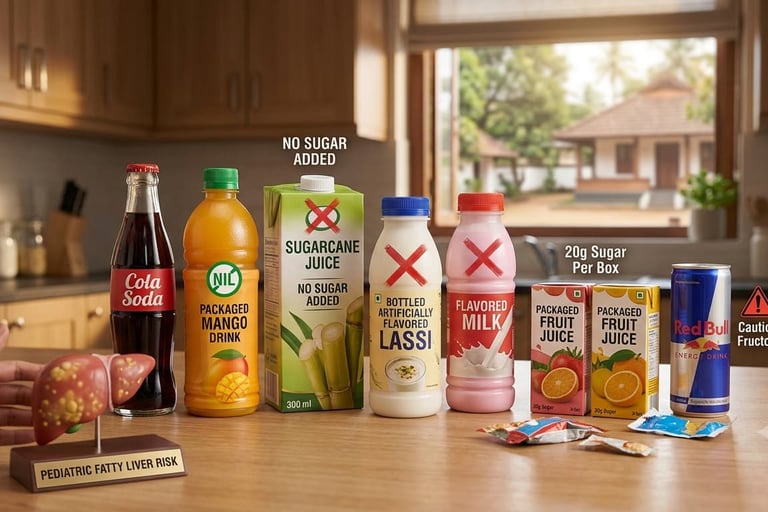
If you change only one thing about your child's diet, make it this. Soft drinks, packaged fruit juices, flavored milks, and energy drinks are the most direct expressways to pediatric fatty liver.
The core issue here is fructose. Unlike glucose, which almost every cell in the body can use for energy, fructose is metabolized almost exclusively by the liver. Furthermore, liquid fructose doesn't trigger our satiety hormones, meaning children can consume massive amounts without ever feeling full.
A standard 250 ml juice box—even one proudly marketed as "100% natural" or "no added sugar"—can pack 20 to 25 grams of sugar. That forces a child's developing liver to work overtime, every single day.
The Indian Context: Packaged mango drinks, commercial sugarcane juice, and bottled, artificially flavored lassis are rampant offenders. I would like to take out names here, but i dont have the time or energy to fight a litigation.Even homemade fruit juices, when stripped of the whole fruit's natural fiber, become a massive, rapid fructose hit to the body.Sodas and carbonated beverages have become a common drink amongst Indian kids.
The Western Context: Sodas, sports drinks, and sweetened "vitamin" waters act as the exact equivalent offenders.Parents should limit children's intake of sugar-rich beverages such as carbonated soft drinks, fruit drinks with added sugar, sweetened iced teas, sports drinks, energy drinks, flavored milkshakes, sweetened coffee beverages, and sugary smoothies. These drinks provide excess sugar with little nutritional value, increasing the risk of obesity, tooth decay, fatty liver disease, and type 2 diabetes. Choose water, milk, and whole fruits instead.
2. Mayonnaise: The Inflammatory Calorie Bomb
Mayonnaise has quietly evolved into a daily staple—slathered on school sandwiches, rolled into wraps, and served as a default dip. It looks harmless, but commercially produced mayonnaise is a nutritional minefield.
Most commercial brands are formulated primarily with highly refined vegetable oils (like soybean or canola oil) that are packed with omega-6 fatty acids. While we need some omega-6s, an overwhelming excess—without the counterbalancing presence of omega-3s—creates a pro-inflammatory environment in a growing body.
Beyond the inflammation, the sheer caloric density combined with hyper-palatability is a dangerous mix. Mayonnaise makes everything taste engineered to crave, leading children to overeat whatever food it accompanies. To make matters worse, commercial jars are frequently stabilized with added sugars, chemical preservatives (like calcium disodium EDTA), and artificial thickeners.
A single tablespoon of commercial mayo delivers roughly 90 to 100 calories, almost entirely from refined fat, with zero structural nutrition. In a child’s smaller body, these empty calories actively displace the nutrient-dense foods they actually need to grow.
The Better Alternative: Try small amounts of homemade mayo blended with extra virgin olive oil, or seamlessly swap it out for hung curd (greek yogurt), mashed avocado, or nutrient-rich hummus.
3. Tomato Ketchup & Store-Bought Sauces: Sugar in Disguise
Many well-meaning parents view store-bought tomato ketchup, pasta sauces, and pizza bases as a "vegetable serving in disguise." In reality, they are closer to dessert.
Most commercial tomato sauces are heavily engineered with added sugars (often high-fructose corn syrup), high sodium, and chemical shelf-stabilizers.
Look at the math: a standard two-tablespoon serving of commercial ketchup contains nearly a full teaspoon of sugar. Jarred pasta sauces can easily hide 8 to 12 grams of sugar per serving, quietly escalating a child's daily fructose burden.
Then there is the sodium load. A child's immature kidneys are far less efficient at processing high salt loads. Early exposure to high-sodium diets essentially "trains" a child's palate to prefer intensely salty, processed profiles, while subtly raising their long-term cardiovascular risks.
The Indian Context: The ubiquitous tomato ketchup bottle present at every meal, ready-made convenience gravies, instant pasta sauces, and packaged chutneys are notorious sodium-and-sugar bombs.
The Fix: Simmering fresh, ripe tomatoes at home with a pinch of herbs and minimal salt is incredibly easy and naturally flavorful. Training a child’s palate to appreciate the true flavor of a tomato—slightly tart, rich, and honest—is one of the greatest long-term health gifts you can give them.
If you cant do this , Still keep them away from commercial tomato ketchup and use alternatives.
4. Ultra-Processed Snacks: The Modern Snack Trap
The modern snack aisle is designed to override a child's natural satiety cues using refined starches, trans fats, and chemical flavor enhancers.
The Indian Snack Red Flags
Instant Noodles & "Masala" Oats: These are high-glycemic, refined flour formulations packed with staggering amounts of sodium and synthetic flavor enhancers like MSG.
Packaged Namkeen & Bhujia: Typically deep-fried in low-grade, heavily refined oils that are repeatedly reheated at high temperatures, turning them into a prime source of dangerous trans fats.
Maida-Based Bakery Items: White bread, puffs, rusks, and samosas made with refined flour cause rapid blood glucose spikes, overworking the pancreas and laying the groundwork for early insulin resistance.
The Western Snack Red Flags
Processed Meats & Chicken Nuggets: Exceptionally high in sodium and synthetic nitrates. In fact, processed meats are classified as Group 1 Carcinogens by the World Health Organization (WHO).
Each 50 gram portion of processed meat eaten daily increases the risk of colorectal cancer by 18%.
Commercial Breakfast Cereals: Most boxes targeted at children contain more sugar by weight than actual grain, turning breakfast into a de facto dessert.
The Ultimate Danger: Trans Fats Have No Safe Dose
If there is one ingredient that should be entirely banned from a child's diet, it is partially hydrogenated vegetable oil—the primary source of artificial trans fats.
Trans fats operate like a systemic wrecking ball: they simultaneously raise "bad" LDL cholesterol, lower "good" HDL cholesterol, trigger severe endothelial inflammation, and directly accelerate fatty liver disease.
While global and regional regulations have tightened around trans fats, regulatory enforcement is rarely perfect. Indian packaged baked goods—like commercial biscuits, cream-filled cookies, and rusks—frequently still harbor these oils.
Doctor’s Tip: Don't just look at the front-of-package marketing or even the basic nutrition table. Turn the box over and read the actual ingredient list. If you see the words "partially hydrogenated vegetable oil" or "shortening," put it back on the shelf.
A Note on Balance, Not Perfection
Please don't misunderstand me: this isn't about clinical perfection. A child who enjoys a slice of pizza or a handful of commercial chips at a birthday party is not in medical danger.
The real clinical concern is the baseline background noise of a child's diet—when ultra-processed items transition from being an occasional treat to the daily, unquestioned default.
A child’s liver is not just a smaller version of an adult liver. It is a rapidly developing, highly metabolic organ. Given the right inputs, it has an incredible capacity to regenerate, adapt, and thrive for decades. Given the wrong inputs consistently, it quietly accumulates structural damage that may not manifest clinically until they are standing in an adult clinic years later.
Feed them real, whole food most of the time. Cook tomatoes from scratch. Skip the industrial jar of mayo. Read the back of the juice box. These are small, daily acts of parenting that cast surprisingly long, healthy shadows.
We need to work on our own diet and more so the diet of the next generation. They are our future!.
Choose wisely... Avoid the sweet trap.
Health
Care
Mind
contactus@bobbyabraham.com